Henri Matisse
French visual artist and leader of the Fauvism art movement.

Francesco Bini · CC BY-SA 4.0
Henri Matisse was a French visual artist who established himself as a leader of the Fauvism art movement in the early 1900s. Fauvism emphasised a strong use of colour and painterly qualities, as opposed to realistic representations found in Impressionist art. His 1912 oil-on-canvas still life painting *Goldfish* (French: *Les Poissons rouges*) is a key work from a series he produced between the spring and early summer of that year. The painting, whose centerpiece includes four goldfish, was created in Matisse's garden conservatory at his home in Issy-les-Moulineaux, where he moved to escape the pressures of Paris.
- nationality
- French
Lore & Background
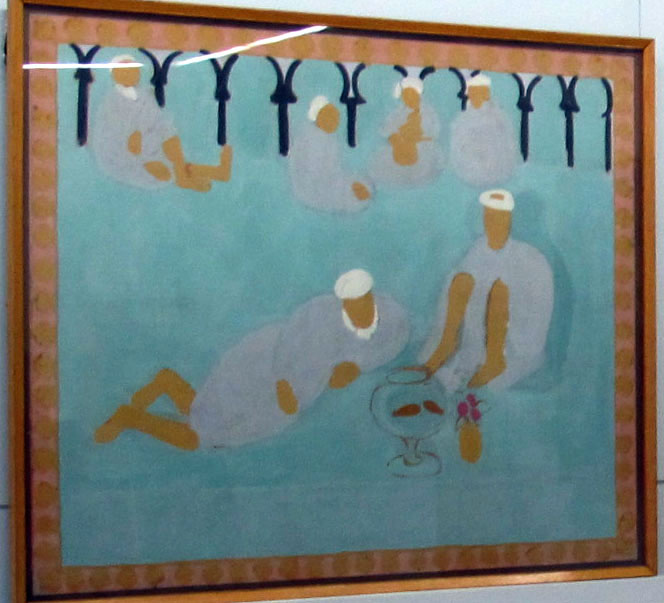
In 1912, Matisse visited Tangier, Morocco, where he noted how the locals would be fascinated by goldfish swimming in bowls. Shortly after his visit to Morocco, he produced a series of paintings that included *Goldfish* between the spring and early summer. The painting was done in his garden conservatory at his home in Issy-les-Moulineaux, a place he moved to in order to escape the pressures of Paris. The motif of fish in aquariums became notable in his work and would become a recurring sight from the early and mid-1910s. The 1912 *Goldfish* painting was unlike other Matisse works featuring goldfish, as the four goldfish themselves are the focus of the piece. Matisse continued the use of bright colours found in his Fauvist work on *Goldfish*, featuring a 'bright orange [that] strongly contrasts with the more subtle pinks and greens that surround the fish bowl and the blue-green background.' The still life includes 'Matisse's own plants, his own garden furniture, and his own fish tank.' Matisse's 'depiction of space' in the piece creates a tension: the goldfish can be seen from two different angles simultaneously—from the front, where the viewer can immediately recognise them, and from above, where they are 'merely suggested by colorful brushstrokes.' The painting illustrates common themes in Matisse's work, including the use of complementary colors (a trademark of Fauvism), an exploration of an 'idyllic paradise,' and a desire to invoke a 'contemplative relaxation' for the viewer.
Reader's Guide
Henri Matisse's *Goldfish* (1912) is a still life that demonstrates his Fauvist approach to colour and composition. The painting was purchased by Sergei Shchukin in Paris from Matisse's studio in 1912 and became part of Shchukin's Pink Drawing Room ensemble in his home. Since 1948, the work has been located at the Pushkin Museum in Moscow, Russia. *Goldfish* holds the distinction of being the featured Matisse work found in the College Board's AP Art History curriculum. For those studying Matisse, this painting is a prime example of his use of bright, contrasting colours and his ability to depict space in a way that challenges the viewer's perspective. The work also reflects Matisse's personal environment, incorporating his own plants, garden furniture, and fish tank, and it captures his fascination with the motif of goldfish that he observed during his 1912 visit to Tangier, Morocco.
Did You Know?
- Matisse's 1912 painting *Goldfish* was part of a series he produced between the spring and early summer of that year.
- The painting was created in Matisse's garden conservatory at his home in Issy-les-Moulineaux, where he moved to escape the pressures of Paris.
- Matisse visited Tangier, Morocco, in 1912 and noted how locals were fascinated by goldfish swimming in bowls.
- The goldfish in the painting can be seen from two different angles simultaneously: from the front and from above.
- Since 1948, *Goldfish* has been located at the Pushkin Museum in Moscow, Russia.
The Genesis of a Series
By the early 1900s, Henri Matisse had cemented his reputation as a driving force behind Fauvism, a movement that championed bold, expressive color and a loose painterly hand over the faithful reproduction of reality that had defined Impressionism. That philosophy would find a particularly intimate expression in the spring and early summer of 1912, when the artist produced a series of still-life canvases centered on goldfish. The spark for the cycle came during a trip to Tangier, Morocco, where Matisse observed local residents gathering around bowls of swimming fish with evident delight. Back in France, he set up his easel in the garden conservatory of his home in Issy-les-Moulineaux, a suburb he had chosen specifically to distance himself from the relentless pace and pressures of Paris. Working in that tranquil, sunlit setting, he painted Goldfish and its companions. The aquarium-and-fish motif would continue to haunt his studio through the early and mid-1910s, becoming one of his most persistent visual obsessions.
Color, Space, and Dual Perspective
What sets Goldfish apart from Matisse's other aquarium paintings is that the four fish themselves command the entire composition; they are not a decorative accent but the undisputed subject. The palette is a textbook demonstration of Fauvist color theory: a vivid, almost incandescent orange defines the fish, set against the softer pinks and greens that dress the bowl and its immediate surroundings, all floating on a cool blue-green ground. The scene is unmistakably personal—a still life drawn from the artist's own conservatory, populated by his own potted plants, his own garden furniture, and his own tank. Perhaps the most striking formal choice is Matisse's treatment of spatial depth. The viewer encounters the goldfish from two vantage points at once: a frontal view that makes them instantly legible as living creatures, and a bird's-eye angle from above, where their forms dissolve into mere suggestions of color and brushstroke. This dual perspective generates a quiet tension, a sense that the painting is simultaneously a window into a real room and an abstract meditation on how we perceive space.
A Window into Contemplative Paradise
Beyond its technical virtuosity, Goldfish operates as a small, self-contained vision of what Matisse repeatedly sought in his work: an idyllic, almost Edenic stillness. The painting is less a documentary record of a fishbowl than an invitation to contemplative relaxation, a visual pause that asks the viewer to slow down and simply look. The complementary color relationships—warm orange set against cool blue-green, bright pinks balanced by muted greens—are not merely decorative; they are the emotional engine of the piece, a hallmark of the Fauvist vocabulary Matisse had been refining since the early 1900s. The recurring presence of fish in aquariums throughout his early and mid-1910s output suggests that the motif carried a personal, almost meditative significance for him, a way of capturing a small, contained world of gentle motion. In Goldfish, that contained world is rendered with enough warmth and enough color to feel like a private paradise, a garden conservatory distilled into a single, breathing moment.
From Private Salon to Public Museum
The journey of Goldfish from Matisse's studio to one of the world's most visited museums is a story that spans more than a century and two continents. In 1912, the Russian collector Sergei Shchukin purchased the canvas directly from Matisse's Paris studio. It found a place in the celebrated Pink Drawing Room of Shchukin's Moscow residence, where it hung alongside other masterworks as part of a carefully curated ensemble. After the upheavals of the twentieth century, the painting entered the public domain: since 1948 it has been housed in the Pushkin Museum of Fine Arts in Moscow, where it remains a cornerstone of the institution's French modern collection. In the twenty-first century, Goldfish has acquired a second life in the classroom. It is the designated Matisse work in the College Board's AP Art History curriculum, meaning that thousands of high-school students across the United States encounter its four orange fish, its dual-perspective composition, and its Fauvist color logic as a gateway into the broader story of early-twentieth-century art.
Gallery
Frequently Asked Questions
Who is Henri Matisse?
Henri Matisse (1869–1954) was a French painter, sculptor, and printmaker celebrated for his bold, expressive use of colour and his fluid, confident line work.
What is Henri Matisse most famous for?
He is best known as a leading Fauve whose saturated, unapologetic palettes broke from academic tradition, and for his late-career cut-paper collages that turned flat colour into a sculptural language.
What is Fauvism and how does it connect to Matisse?
Fauvism was an early-twentieth-century French movement defined by wild, non-naturalistic colour applied in broad, flat strokes; Matisse is widely regarded as its central figure and most enduring practitioner.
How did Matisse's work evolve in his later years?
After a serious operation in 1941 left him largely unable to stand at an easel, he pivoted to cutting and arranging sheets of painted paper, producing the vibrant, mosaic-like compositions he is now equally identified with.
Why is Henri Matisse considered so important in art history?
Together with Pablo Picasso, Matisse is credited with fundamentally reshaping modern visual art by freeing colour and line from descriptive obligation and proving that sensation and rhythm could be the primary subjects of a painting.
More in Visual Artists 1-24
Elsewhere in the Visual Artists universe
Spotted an error? Know more?
This is a living reference — every entry is fact-audited, and reader corrections feed straight into our audit queue. Suggest an edit · See this site's audit record